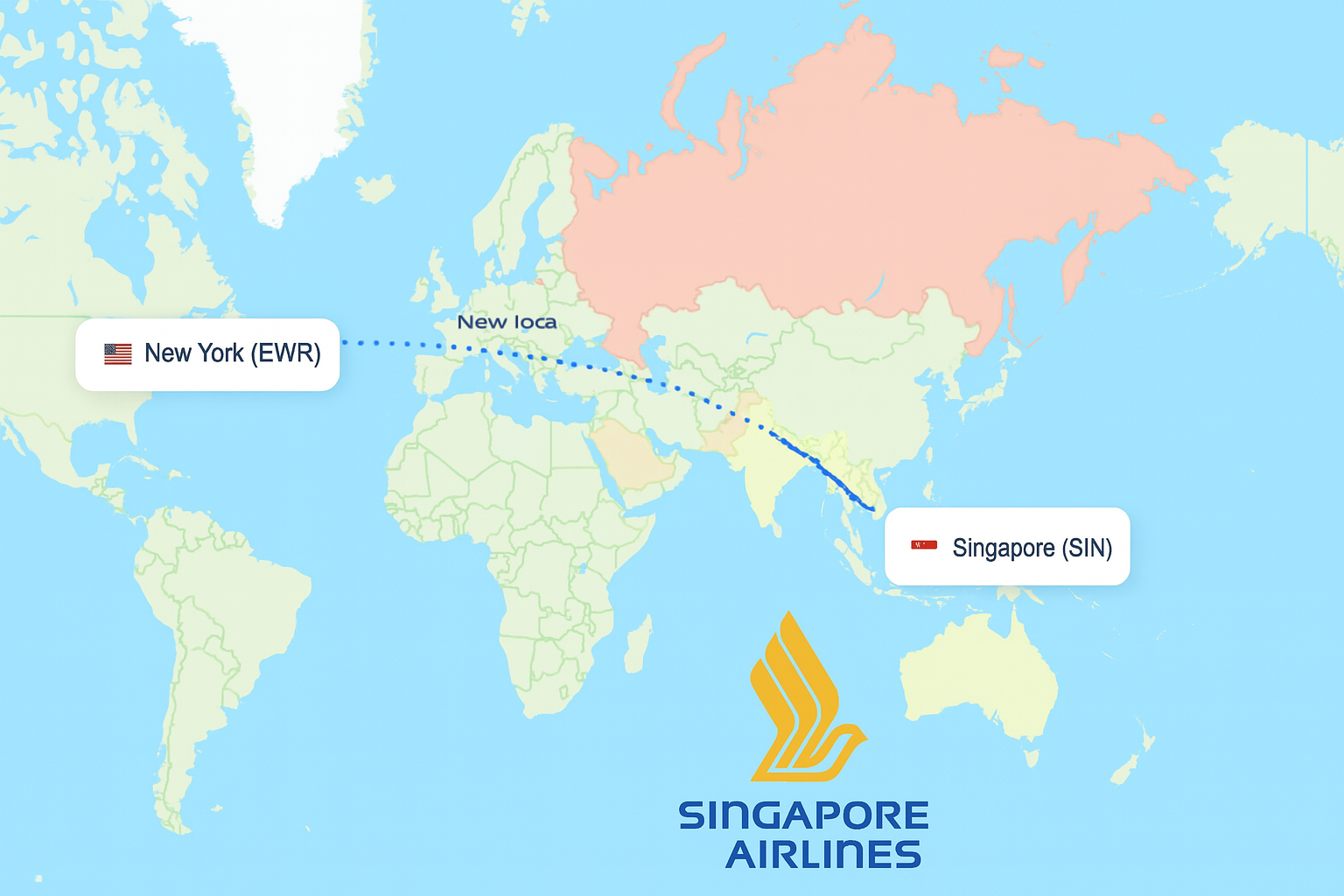
As an aviation enthusiast, there are a few milestones that feel like rites of passage: flying on the Concorde (if you were lucky), logging a ride on the A380, spotting a rare livery in the wild—and for me, experiencing one of the longest commercial flights on Earth. I recently fulfilled that goal by flying Singapore Airlines Flight 21, which connects Newark Liberty International Airport (EWR) to Singapore Changi Airport (SIN), a jaw-dropping 9,537 miles in a single leap.
That makes it the second longest nonstop commercial flight in the world, trailing only the sister route between JFK and Singapore, which is slightly longer by less than three miles. Yes—three miles. We’re splitting hairs, but aviation records do.
Route of Legends: A Brief History of Ultra-Long-Haul Flights
Ultra‑long‑haul (ULH) flights—those that stretch passenger endurance and aircraft capability to their limits—are a marvel of aviation innovation. Here’s how this extraordinary class of travel evolved:
1. Flying Boats & the Double Sunrise (1930s–1940s)
In 1936, Pan Am’s Martin M‑130 “China Clipper” inaugurated the first commercial transpacific passenger service from San Francisco to Pearl Harbor (~3,900 km)
By 1943, Qantas’ Catalina “Double Sunrise” seaplanes flew nonstop from Perth to Ceylon (modern‑day Sri Lanka), covering ~5,650 km in up to 32 hours. These clandestine missions—so named because passengers witnessed two sunrises aboard—remain the longest-duration commercial flights ever.
2. Piston-Era Records (1950s)
Post‑war, piston propeller aircraft held the spotlight: KLM’s Lockheed Constellation reached Batavia (~5,500 km in 1949), and TWA’s L‑1649A Starliner flew nonstop between London and San Francisco over 8,600 km in 1957.
3. The Jet Age & ETOPS (1960s–1990s)
Jetliners like the Boeing 707 and 747 ushered in a new era. Advances in engine reliability and ETOPS regulations allowed twinjets to cross oceans nonstop, reshaping global route networks.
4. The A340‑500 Era – The Reign of Singapore Airlines (2004–2013)
On 28 June 2004, Singapore Airlines launched SQ21/SQ22 between Singapore and Newark using the four‑engine Airbus A340‑500. That route spanned an astonishing 15,344 km and lasted just over 18 hours—then the world’s longest commercial flight.
Cost and fuel inefficiency forced its suspension on November 23, 2013.
5. Enter the A350‑900ULR (2018–2020)
With the launch customer order on 13 October 2015, Singapore Airlines introduced the Airbus A350‑900ULR—an aircraft boasting up to 25 % better fuel efficiency and redesigned for ULH missions.
OnOctober 11, 2018, SQ21/SQ22 was relaunched with the A350‑ULR, restoring Newark–Singapore as a nonstop service.
Then, on November 9, 2020, SQ23/SQ24 took over as the world’s longest commercial route, connecting JFK–Singapore over ~15,349 km in around 19 hours.
6. The Next Frontier – Project Sunrise & Beyond
Qantas’ Project Sunrise will soon challenge existing limits with nonstop flights from Sydney to London and New York aboard the A350‑1000ULR, targeting durations of up to ~20 hours and distances around 17,800 km by 2027.
18+ Hours in the Sky: My Experience
To put it plainly: the flight was long. 18 hours and 45 minutes, to be exact. That’s a full waking day spent inside a pressurized metal tube, traversing the curvature of the Earth.
And yet—it was incredible.
Here’s how it went:
Boarding from Newark: Not exactly the most inspiring start—Newark’s international terminal can be chaotic and cramped. But once I stepped onto the Singapore Airlines A350, I was greeted with a familiar warmth. The crew’s hospitality never misses.
Seating: I was in business class. The seat transforms into a fully flat bed, but there’s a catch: unlike other airlines (like ANA’s “The Room” or Qatar’s Qsuite), this seat must be manually flipped into a bed. It’s not a smooth recline—you actually have to get up or ask the crew. Not ideal.
Comfort: Once in bed mode, it wasn’t the most comfortable. It was actually pretty hard due to lack of mattress. I managed about 5.5–6 hours of sleep, broken into two sessions. Noise levels, however, were impressively low—the A350-900ULR is significantly quieter than the Boeing 777 I once swore by.
Entertainment: Plenty of movies, but the system is showing its age. It’s not touchscreen, not 4K, and lacks a tail or nose cam—something aviation fans (like me) always look for.
Food & Service: Solid. The food was well-executed, and the crew were courteous, efficient, and gracious. But nothing wowed me. I almost wish I had a bigger appetite to enjoy it more!
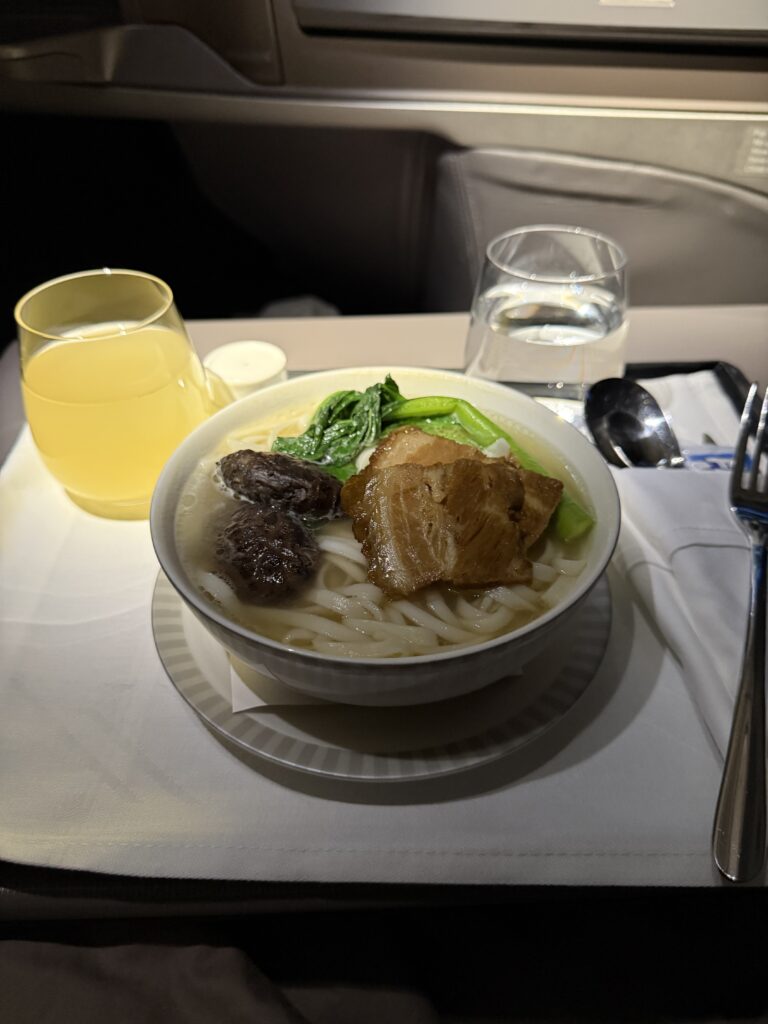
During mid-flight, I woke up and ordered a pork noodle soup, and it was delicious.
Flight Path: Not What You’d Expect
Many assume this route crosses the Pacific—but it doesn’t. Instead, we flew east, over the Atlantic, past Europe, Central Asia, India, then Southeast Asia, finally descending into Changi.
Why? It’s due to jet stream patterns, air traffic control, geopolitical factors, and fuel efficiency. Sometimes the shortest path on a globe isn’t the fastest in real-world conditions.
Perspective: The Magic of Aviation Engineering
There was a moment mid-flight when I opened the window and stared into the sky. The screen said we were near Georgia, and I thought: How amazing is this?
In under 19 hours, I went from the East Coast of the United States to a tiny island nation halfway across the globe. No layovers. No dashing across airports in Tokyo or Dubai. Just human ingenuity, aviation engineering, and a good pair of noise-canceling headphones.
I’ve flown to China via connections, and those trips always took 22–26 hours door-to-door. This was vastly more efficient and surreal.
Comparing Products: Room to Improve
While I love Singapore Airlines, and their service remains top-tier, their hard product—meaning the seat—feels due for an update. Compared to the ANA “Room” or Etihad’s new business seats, this one is less flexible and not intuitive for comfort.
There’s also no amenity kit handed out at your seat, though you’ll find essentials in the lavatories.
Looking Forward
I’m proud to say I’ve flown on one of the longest commercial flights in history. And even though it’s just a few miles short of the longest, I’d do it again.
Will I choose Singapore Airlines next time? Probably—but I’ll also keep an eye on what other airlines are offering on these ultra-long routes. For now, Singapore Airlines remains a leader, but the competition is catching up in comfort and innovation.
Aviation Facts You May Not Know
The longest commercial flight in history (by distance) is JFK to Singapore (SQ23) at 9,537 miles, followed closely by EWR to Singapore (SQ21) at 9,534 miles.
The longest flight by duration can vary depending on winds. In some cases, flights from Auckland to Doha or Perth to London exceed 18 hours.
The new Qantas “Project Sunrise” aims to connect Sydney to London and New York non-stop by 2026, with projected flight times of 20+ hours using an ultra-long-range Airbus A350-1000.
Final Thoughts
This wasn’t the most luxurious flight I’ve ever taken, nor the most restful. But it was one of the most meaningful. For aviation lovers, it’s not just about flying—it’s about appreciating how far we’ve come. From the Wright brothers in 1903to 9,500-mile nonstop flights, we are living in a golden age of global connectivity.
This flight was a quiet, smooth, modern miracle.
And I’m glad I was on it.
Have you flown on an ultra-long-haul flight? What’s your experience like? Would you do it again? Share your thoughts below.